Nepal last month released the revised political and administrative map of the country laying claim over the strategically key areas, more than six months after India published a new map in November 2019.
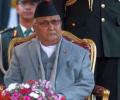
'The redrawing of the map with the inclusion of Kalapani area by Nepal and endorsement from the House of Representatives shows the KP Oli government's move to gain cheap popularity in the name of nationalism'

India last month reacted angrily to Nepal showing the three areas as Nepalese territory in the new map and cautioned the country that saying such "artificial enlargement" of territorial claims will not be acceptable to it. India has been maintaining that these three areas belong to it.
A house meeting has been scheduled for Saturday as per the Parliament's notice and the matter relating to the constitution amendment bill is likely to come during the meeting, parliamentary sources said. Meanwhile, in a conciliatory tone, India on Thursday said it deeply values its friendly ties with Nepal.
He claimed that India built a Kali temple, created 'an artificial Kali river' and 'encroached the Nepalese territory through deploying the Army' at Kalapani. The river defines the border between the two countries.
The ties between India and Nepal came under strain after defence minister Rajnath Singh inaugurated a 80-km-long strategically crucial road connecting the Lipulekh pass with Dharchula in Uttarakhand on May 8.
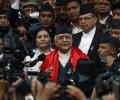
Nepal recently released the revised political and administrative map of the country laying claim over the strategically key areas of Lipulekh, Kalapani and Limpiyadhura.
The government had registered the amendment proposal in Parliament on May 22 after releasing the new political map of Nepal depicting Kalapani, Lipulekh and Limipiyadhura as its territories on May 18.
Speaking about the COVID-19 pandemic in Parliament on Tuesday, Oli said it has become very difficult for Nepal to contain the spread of the deadly virus due to the flow of people from outside.

Oli said the territories belong to Nepal 'but India has made it a disputed area by keeping its Army there'. "Nepalis were blocked from going there after India stationed its Army," he said.
Both India and Nepal claim Kalapani as an integral part of their territory -- India as part of Uttarakhand's Pithoragarh district and Nepal as part of Dharchula district.
The Lipulekh pass is a far western point near Kalapani, a disputed border area between Nepal and India.

In a televised address to the nation, Singapore Prime Minister Lee said the government was committed to do its "utmost" to keep the deadly virus at bay.

Most workplaces, with the exception of essential services and key economic sectors, will be closed. Food establishments, markets and supermarkets, clinics, hospitals, utilities, transport and key banking services will remain open.

The Singapore Airlines agreed to fly the stranded passengers to India, as there is no scheduled Air India flight for Thursday.
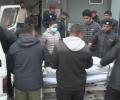
The Department of Tourism said that a five-member committee has been formed to investigate if the resort was following the standards set by the government.
The deceased -- two couples and four children -- were part of a group of 15 people travelling from Kerala to Pokhara, a popular mountainous tourist destination. They have been identified as Praveen Krishnan Nair, Saranya Sasi, Sreebhadra Praveen, Aarcha Praveen, Abhinav Saranya Nair, Ranjith Kumar Adatholath Punathil, Indu Lakshmi Peethambaran Ragalatha and Vyshnav Ranjith.

The body of a 28-year-old Indian construction worker, who died in a crane collapse accident in Singapore on Monday, is being flown back to Tamil Nadu where his wife, pregnant with their first child, and parents await.
"We see the Indian economy rebounding from our projected 6.1 per cent growth this fiscal year to something like 7 per cent in the next fiscal year (2020). We see the factors that will support growth, including monetary policy stimulus, working their way through the pipeline," Jonathan Ostry, Deputy Director, Asia Pacific Department at the IMF, told reporters.

Beijing views the India-based Dalai Lama, the spiritual leader of the Tibetan people, as a separatist trying to split the Himalayan region from China.
